
Entrez votre terme de recherche ci-dessus.

Those who find themselves caring for a loved one often realize the difficulty it can be to help them access doorways and entrances. There are different types of wheelchair ramps suitable for use in a home setting.  Here is a look at some of the available options.

Aluminum Ramp

A popular material for ramps allowing access to a home is aluminum. These usually come in modules to be fit together. These modules work for most homes. You can also order a customized ramp if there are issues getting into the home. Aluminum wheelchair ramps are strong but lighter than other ramp materials which makes them ideal for moving around if needed. They also have a good strength-to-weight ratio so they are durable and safe.

Threshold Ramps

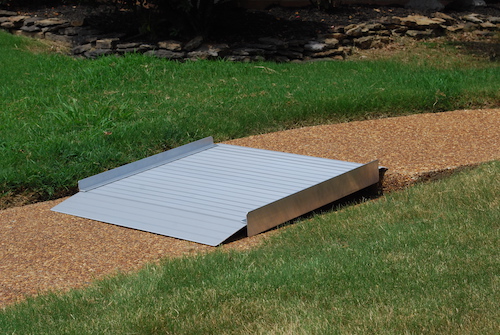
A threshold ramp, as the name implies, is designed to be used in a single doorway or opening in the home. It’s designed for an inside doorway, and one with a short rise. Even a seemingly small rise of 1.5” can be difficult when trying to get a wheelchair through the door. These come in a standard size and offer a safe incline for a wheelchair user to get up and down the ramp. Extra-wide threshold ramps are also available for larger entryways.

Portable Ramp

Portable ramps come in a variety of materials and sizes. The least expensive and lightest is made of aluminum. Portable options are available in different lengths and folding configurations to suit the need. They are designed to go along with you in a vehicle and use whenever, wherever they are needed. Whether at home or away, a portable ramp allows access to uneven surfaces like stairs or raised surfaces. The ramp is simply placed over the obstacle. 

The single-fold ramp is designed to be folded easily and carried to the location where it is needed. It can be installed in just a few minutes and taken down quickly when done. Multi-fold portable ramps extend farther than the single-fold ramp. They can be folded multiple times so it becomes a small pack that is easily portable. The longer length is beneficial when covering a longer distance, or a taller obstacle needing more length to cover the additional height.

Interested in getting a wheelchair ramp for your home? Nous contacter at Next Day Access and let us help you make your house more accessible for you and your loved ones.


Wheelchair-Money_Small-628x353Home accessibility modifications can often be costly expenses that not only require customization, but the cost of professional labor and installation. However, often these expenses can’t be avoided as seniors want to age in place and remain in their homes for as long as possible.


At Accès le lendemain, we’re committed to helping you live a safe and mobile life within your home. To help advance that mission, here are some resources that will help you find funding for home accessibility modifications.

Federal & State Organizations

  • The Department of Veterans Affairs (VA) provides grants for some service members and veterans with certain permanent and total service-connected disabilities to help them buy or build an adapted home, modify an existing home, or otherwise accommodate their disability. The two grant programs are the Specially Adapted Housing (SAH) grant and the Special Housing Adaptation (SHA) grant. You can apply online or call the VA at 1-800-827-1000 to have a claim form mailed to you.
  • The United Spinal Association offers a guide on home modifications, including information about resources that can help individuals with spinal cord injuries pay for home accessibility modifications. The American Occupational Therapy Association has more information as well.
  • According to Eldercare.gov, many minor home modifications and repairs cost between $150 and $2,000. Some home remodeling contractors offer reduced rates and charge sliding-scale fees based on a person’s income and ability to pay.  Some state Area Agencies on Aging (AAA) have home modification programs or can refer you to other organizations that can help pay for home repairs and modifications.
  • The USDA’s Single Family Housing Repair program provides loans to very low-income homeowners to repair, improve or modernize their homes and grants to elderly very low-income homeowners to remove health and safety hazards. Contact your USDA state office for more information about this program.
  • Some state housing finance agencies have loan programs that help people with disabilities (or who have a family member living in the household  with disabilities) who are buying a home that needs accessibility modifications. Many states have home modification programs that are part of their state Assistive Technology programs.  These programs provide low-interest loans to buy assistive technology or to help pay for home modifications and adaptations to make your home safe and accessible.

Private Organizations and Nonprofits

  • The National Resource Center on Supportive Housing and Home Modification promotes aging in place for seniors and people who are aging with a disability. The Center gives families and individuals the knowledge they need to plan for their housing, health and supportive service needs. Check your state’s listings for agencies and organizations near you that can help with home modifications.
  • Rebuilding Together is a nonprofit organization that provides home repair and modification services for low-income families, people with disabilities, seniors and Veterans and military families. Also helps families whose homes have been damaged by natural disasters. Contact your local affiliate for more information.
  • Your local Independent Living Center (ILC) may be able to make some suggestions about how to pay for home modifications such as adding a wheelchair ramp or widening the doorway to your bathroom. ILCs also provide advocacy and support services for people with disabilities, including assistance with housing, health care and independent living skills.
  • Easy Access Housing for Easier Living is a brochure from Easter Seals that has tips on how to adapt your home to accommodate a person with a disability. Your local Easter Seals chapter  can provide you with information about possible financing options to pay for modifications to make your home accessible.
  • Your local Aging and Disability Resource Center (ADRC) may be able to refer you to an organization or company that provides home modifications services. ADRCs offer information on long-term supports and services for older adults and people with disabilities.

To learn more about home accessibility modifications, products, services, and installations, or to schedule your free home accessibility assessment, give us a call today at (800) 423-0751.

The October/November issue of AARP Magazine observed that there are 40 million caregivers in the United States and called them “the real American nobility.”

Editor in Chief Robert Love also observed, “We humans show our nobility when we put ourselves aside and care for those in need.

Help For Caregivers

help for caregivers

Caregiving doesn’t come without taking a toll. The American Psychological Association has a long list of the common problems that may affect caregivers, such as depression, anxiety, sleep problems and risk of injury.

Next Day Access knows very well the strains under which caregivers operate and can provide many solutions in home accessibility that mitigate the inherent problems in this potentially difficult time of life. Home Caregivers can get help from Next Day Access’ product line to reduce the risk of injury by making their jobs simpler and safer.

In families where a wheelchair is in use and wheelchair access to the home or garage has been impeded, Next Day Access can equip that residence with the finest in wheelchair ramps. Caregivers can then more easily move their loved one with less physical effort and fear of a fall.

How Next Day Access Helps Caregivers

A Next Day Access patient lift in the bedroom can be a crucial part of accessibility solutions. A patient lift is a device used to help a caregiver move a patient – from a bed to a wheelchair, from the bed to other household areas, or from a bed to a bathroom to access a bathtub, shower and toilet. The lift prevents injury to the caregiver or patient while movement takes place.

Look to Next Day Access to deliver a “whole home, whole life” plan for accessibility. Whole home means we can address each area of your home and recommend a professional accessibility solution that allows patients and caretakers the freedom and independence to enjoy every level of their home. Whole life means we can adapt the home to meet today’s needs, as well as those of tomorrow.

Caretakers need not do their work alone. Not when Next Day Access stands ready to provide a free in-home estimate once you make that first call.

Avis des clients

FrançaisEspañolEnglish