
Entrez votre terme de recherche ci-dessus.

Unfortunately, the world is not designed for people who utilize a wheelchair or have limited mobility. However, with the latest technology, you can more easily navigate the places you plan on visiting. From mobility friendly venues to taxis with accessible options, these apps can help make sure you are able to get out and explore!

Go Touch Free

With both newer iOS and Android devices, you can have your phone perform tasks just by speaking. Both platforms have intelligent assistants that can do things by simply activating them. If you are an iOS user, you simply need to say “hey Siri” to begin the process of asking your phone to complete a task. For Android users, you need only say “ok Google” to get the process started. From there, you can have your device write a text message, call someone, or even search for something online.

Wheelmap

This app is truly a must for anyone who has accessibility needs. Wheelmap allows you to see which buildings and public areas are fully, partially or not accessible to wheelchair users. It also allows a user to add their own input if a building is marked as unknown.

Wheelmate

Similar to Wheelmap, Wheelmate is another great app for anyone with accessibility needs. Unlike Wheelmap though, it focuses on smaller, but just as important, accessibility concerns. From wheelchair and mobility scooter accessible parking spaces to bathrooms, Wheelmate’s focus is on practical concerns of being out in public.

Taxi Services

From Uber to Lyft, there are many mobile taxi apps available. However, what is great about these modern applications is that you are able to see and request a ride that is wheelchair accessible. One other convenient aspect about these services is that you don’t need a wallet full of cash for your ride. You preload your credit card of choice into the app and it securely charges you once the ride is over. You even have the option of adding a tip to some services if you choose to.

Making Wheelchair Mobility Easier

Although the world wasn’t designed with those that have accessibility needs in mind, it doesn’t mean you need to shy away from getting out. Technology has opened new doors for everyone and can help you plan your next trip in advance. From going hands-free to finding a wheelchair accessible ride, technology can help you plan your next outing.

Most would consider the blustery winds and the chill in the air to be a reason to stay inside and cozy up. And we wouldn’t blame them. Working up the nerve to continue your exercise routine in frigid temperatures can mean you’re sidelined for the winter but it doesn’t have to be that way. Here are some tips and tricks to staying limber and lean throughout the winter!

  1. Tai Chi – It’s been called a gentle way to fight stress and was designed to teach self-defense, but now you can find it as a form of relaxing, muscle-building and flexibility-increasing workout. The great thing about Tai Chi, is it is low-impact and can be done virtually anywhere. No special equipment is required to complete the workouts. This is a great workout for caregivers looking for an outlet to relieve stress.
  1. Chair Yoga – Did you know that increased flexibility helps prevent against injuries and chronic joint pain? Chair Yoga is the perfect exercise to increase flexibility and increase strength and stability. Poses like Seated Mountain, Eagle Arms and Warrior I can all be done at the kitchen table and adaptations can be made to help complete the exercises.
  1. Swimming – Taking a dip in the pool can help you escape the dreary winter cold. Taking a few laps in the pool or even just walking or treading water can get your heartrate up and give you an activity to do with friends. Other options to consider when it comes to the pool is water aerobics and other fitness classes.
  1. Limbering Stretches – If you’re not able to complete other workouts, you may consider some limbering stretches to keep your body moving and flexible. Rolling your neck, extending your legs and reaching your arms out can help keep you active. These moves should be done every three times a week at the minimum to keep your body in tip-top shape.

Increase your day-to-day physical abilities with these simple indoor activities this winter. Don’t let the winter hold you back from maintaining your health and exercise regimen with these indoor workouts. How do you stay active during the winter? Tell us in the comments below.

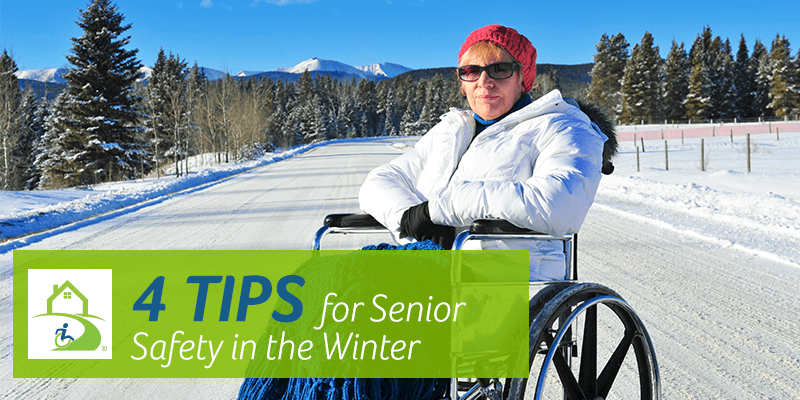
The beauty of a peaceful snowfall may look idyllic, but in reality there are lurking dangers when it comes to winter weather. There are numerous risks while being out during winter weather, especially for senior citizens who are more prone to falls and injuries. To help protect yourself or a loved one this winter, consider these four tips.

  1. Watch for Ice: One in three adults over the age of 65 falls each year. As people age, their recovery process from falls can cause many other health setbacks. In order to prevent falls, ensure your winter shoes are designed for great traction and non-skid bottoms. Have a family member or neighbor, de-ice your walkways if you must go outside. Our open-weave residential ramp is perfect for those who live in snowy and icy conditions. This ramp offers great two-way traction for wheel and power chairs.

  1. Dress Warmly: As temperatures dip lower, it’s important to remember to bundle up while you’re outside. Exposure to cold temperatures for prolonged periods of time can lead to frostbite and hypothermia. Those who are older than 65, are at much greater risk for hypothermia deaths, according to the CDC, due to age and decreased circulation. Never allow temperatures to dip too low indoors, since the body temperature should never go below 95 degrees.
  1. Prepare Vehicles: Driving during winter and icy weather can be a test for even the best drivers. As reflexes and reaction times become diminished as we age, it may not be safe for seniors to be on the road while icy or snowy. As the winter season approaches, it’s important to have your car serviced for winter weather and the gas tank full at all times. Always keep a first aid kit in your car, along with emergency kits including a flashlight, reflectors and blankets.
  1. Power Outages: As icy weather can overtake power lines, it’s critical you have the necessary equipment in order to maintain your healthcare regimen. Having a backup generator installed can ensure equipment like ventilators, Monte-escaliers and Ascenseurs à domicile will continue to run and, of course, can keep the heat running.

As you prepare for the winter weather, be sure to refer to the CDC’s Winter Weather Checklist. If you’re looking for more information on the products that can help you stay safe during the winter, contact us here.

As we age, it is common to encounter new and unexpected health challenges. Managing chronic health conditions becomes a crucial aspect of leading a fulfilling and balanced life. Whether it’s for ourselves or our loved ones, understanding and effectively navigating these conditions is essential. From cardiovascular issues to respiratory ailments, chronic health conditions can significantly impact our well-being.

In this article, we will explore the importance of managing these top chronic health conditions and discuss the guidance that can help individuals and their families embrace a proactive approach towards better health.

Tips to Managing Top Chronic Health Conditions

  1. High Blood Pressure

Did you know 29 percent of adults in the U.S. have high blood pressure? High blood pressure can lead to serious issues like stroke and heart attack. To ensure you’re keeping your blood pressure under control consider limiting your sodium intake, exercising regularly, and working on losing weight. While your level of activity and eating choices heavily impact your blood pressure, you should remember stress does too. Look for ways to keep yourself calm and away from stressful situations as well.

  1. High Cholesterol

High Cholesterol is similar to high blood pressure in the fact that it can sneak up on you before you realize what’s going on. That’s why it’s critical that you schedule regular doctor’s appointments to have blood drawn and tested. In order to prevent or combat high cholesterol start by consuming less saturated fats, alcohol and trans fats. Staying active and watching what you eat also greatly contribute to maintaining a lower cholesterol level.

  1. Arthritis

As we age, our joint cartilage begins to break down, leading to osteoarthritis, one of the most common forms of arthritis. To help prevent the unwanted stiff and achy joints, you’ll want to maintain the recommended body weight for your stature, look for ways to prevent trips and falls, and, of course, exercising regularly.

  1. Coronary Heart Disease

Stemming from other conditions like high blood pressure and cholesterol, coronary heart disease leads to heart attacks, blood clots and more. If you’re taking the steps to lower your blood pressure or cholesterol, you’re always taking the right steps to lowering your risk for coronary heart disease.

  1. Diabetes

This condition is a mounting threat to the American people, as more than 30.3 million people are now treating and managing their diabetes. Not caring for diabetes can lead to many other health issues, no one wants to face, including kidney disease, blindness and nerve damage. If you are diagnosed with pre-diabetes, it’s recommended you lose up to 7 percent of your body weight to help reduce your risk. Much like the other conditions mentioned above, exercising for 30 minutes a day, five times a week and maintaining a healthy diet significantly reduces your risk.

Are You Managing Top Chronic Health Conditions?

As the New Year rolls around, now is the perfect time to start setting health-focused goals for you and your family. Understanding way for managing top chronic health conditions can go a long way in preventing and managing these conditions.

If you need help with mobility in order to help in managing top chronic health conditions, contact the experts at Accès le lendemain to learn about our accessibility products and solutions.

tips to fund home modification

It’s no secret home modification can come with a hefty price tag. And receiving funding to help with home modification costs can be a difficult task. To assist, we’ve come up with a few solutions to help reduce cost as you look to modify your home.

Insurance Coverage

The first thing that comes to mind as a funding option is your insurance provider. You should reach out to them to understand your terms of coverage and policy.

Medicaid offers a Home and Community Based Services waiver. Through this, home modification costs are sometimes considered and reimbursed.

Medicare currently does not pay for home modifications. They do sometimes assist with durable medical equipment for the home. If a doctor prescribes equipment as medically necessary, there’s potential to have Medicare cover the expense.

Tax Deductions

You may be able to deduct certain equipment and home modifications as medical expenses. As long as your medical expenses exceed 7.5 percent (10 percent if you’re under 65) of your income, you can deduct this for tax purposes. Like Medicare, a note from your doctor stating the modifications was medically necessary can help secure the tax deduction.

Grants

There are several local, national, government and private grants you can apply for. There are specific grants for veterans, residents of rural areas, and those who are looking to be self-sufficient but aren’t classified as a low-income household. We encourage you to reach out to your medical provider to see if they know of any grants.

Long-Term Care Policy

A long-term care policy could help cover some or all of the home modifications. Work with your policy provider to understand what is and isn��t covered. Also, clarify how using the policy will impact your terms later on.

If you have questions about home modification, Nous contacter today. To learn more how we can assist you in making your home safe aging find a location near you!

Guide to Finding the Right Ramp

So you’re looking for an accessibility solution, but you’re not entirely sure where to start? That’s where we, at Next Day Access, come in! Let us help you discover what questions need to be asked and how to find the answers with these examples below.

  1. What are you using your ramp for?

    1. While you many may think a ramp selection is straightforward, there are many factors to consider.
      1. If you’re just looking to even out an entry, exit or doorway, we encourage you to look at a threshold ramp. Offered in aluminum, rubber or plastic, this solution makes for an easier accessibility point for those in wheelchairs.
      2. We also offer an extra-wide threshold that spans 42-inches and comes with handrails to offer increased stability as one moves through the threshold.
  • If you’re working around a porch with steps, your best bet will be to use a wheelchair ramp. These ramps come in a variety of materials and can be specifically configured to meet your needs and the specifications of your home.
  1. What kind of material do I need to use?

    1. Like we mentioned above, our wheelchair ramps come in a variety of materials. So what should you consider when it comes to the material used for the ramp?
      1. Weather – If you live an area that experiences a lot of snow and ice, our open-weave ramp may be a more practical solution to your needs. If you live in a high-humidity environment, aluminum may be better to use versus our wood-aluminum ramps which could eventually effect traction when it becomes wet. Assess your climate and we can help you find the right ramp for whatever weather you face!
      2. Maintenance – Nothing will escape maintenance but some ramps require a little less or can be done more efficiently. If you’re looking for a low-maintenance, extended use ramp we can help you find the perfect one. If you’re needing a temporary solution and anticipate it requiring little to no maintenance, we can also assist you in the discovery process.

  1. How long does my ramp need to be?

    1. According to ADA guidelines, mobility ramps need to be one foot long for every one inch lift. So if you have ramp that’s lifted 6 inches, the corresponding ramp length will need to be six feet. The ramp must also be 36-inches wide in order to be ADA compliant. We can assist you in the measuring and planning process to ensure the ramp is safe, secure and compliant.

If you have any questions concerning your accessibility needs, we’re here to help. Take a look at what brands we carry and the variety of solutions we can offer you. Nous contacter today for more information and to receive a free estimate!

As the number of those seeking to age in their own home grows, homes are going to have to meet needs that maybe weren’t anticipated when purchased. With almost two-thirds of falls each year occurring in the home, it’s important to make some changes to enhance the safety of a home. If you or a loved one falls into the group of wanting to age in place, here are some tips to prepare your home.

Bathrooms

Out of all the falls that occur for those over 65, 80 percent of them happen in the bathroom. With a few adjustments, you or a loved one doesn’t have to be a part of the 80 percent.

    1. For additional support add Barres d'appui in the bathtub, shower and by the toilet.
    2. Install slip resistant mats inside and outside showers and tubs.
    3. Place products in easy to reach areas.

Floors

In 2002, 1.6 million people were treated for serious falls. Most of the time tripping hazards are overlooked but with a few adjustments, these risks can be mitigated.

  1. Rearrange furniture to make clear paths.
  2. Remove throw rugs or fasten them to the ground to keep from slipping.
  3. Make sure objects like shoes, blankets, and toys have places to be put up or stored.
  4. Wrap cords so they’re not in a walking path.

Stairs

Stairs can be tricky even for the soundest footed. A few quick and easy repairs can help prevent falls and slips.

  1. Fix loose steps and handrails
  2. Add a light above the stairs, with switches at the top and bottom of the stairs.
  3. If climbing stairs isn’t a possibility, consider a stair lift or residential elevator.

Kitchen

The kitchen can be a dangerous place no matter who’s in it. As we age, our ability to quickly respond diminishes so taking the correct precautions can help reduce the number of incidents in the kitchen.

  1. Move things from higher shelves and cabinets to lower shelves, cabinets and countertops.
  2. Equip appliances with automatic shut-offs and check ventilation is properly working.
  3. Replace glass dishes with plastic or unbreakable ones.

Bedrooms

Sometimes the bedroom can be overlooked when making a home safer. We suggest making the following adjustments.

  1. Place light features and switches so they’re easy to reach from the bed.
  2. Add night-lights and keep walkways clear for a maneuverable path to the bed.

The Center for Disease Control says that 30 to 50 percent of falls can be prevented with a few home modifications. Making a few adjustments and running through this checklist can help get on the right path to a safer home. If you’re needing any assistance in the home modification process, Nous contacter today.

Recovery Hacks - Ways to Ease the Recovery Process

Recovering from surgery can be a stressful process. Things you would consider simple seem to be a daunting task when surgery recovery hinders your mobility. So what can you do to make your recovery process one that is full of rest and relaxation? Try a couple of these recovery hacks!

Prep Your Bedroom

If your bedroom is on the second floor of your home we suggest setting up camp downstairs during recovery. Set up everything you think you may need, including your pillows, blankets, chargers, and necessities to make your temporary bed comfortable. If you’ll be recovering in your room make sure all your items you think you’ll need are within arm’s reach, this includes remotes, books, additional blankets, drinks and snacks.

Getting through the Door

If you’ll be in a wheelchair, using a walker or some kind of scooter, getting into your threshold can be an obstacle after surgery. Renting a wheelchair ramp from us during the duration of your recovery can help ease the challenge of recovery. With three different residential ramp options, you can find and configure the ramps for what works best for your home.

Ask for Help

There’s nothing wrong with asking for help! Having someone help you a few days after surgery can be a huge asset. While you can prep as much as possible, unexpected things happen and having an extra set of hands to help you get around, with food or other tasks can be a huge relief.

Keeping it Clean

If you’re unable to access your shower or bathtub or simply can’t get your surgical incision wet, our portable shower may be the option you’re looking for! It’s lightweight and can be set up near any access to warm water. Clean yourself with better control and precision than your shower.

Clear the Path

Before surgery, you’ll want to take inventory of tripping hazards in your home, including power cords, rugs and uneven flooring. Simply rolling up rugs, tying up cords and evening out entries with threshold ramps can prevent potential hazards that could set back recovery.

While it may be a little work beforehand, these steps can help your recovery in the long run. We hope a few of these tips can ease your recovery process and make the healing transition as smooth as possible. To learn about how we can help with your recovery, contact us here!

Schools, hospitals and medical clinics are accustomed to heavy wheelchair traffic. How can they best create a safe and easy path in and out for wheelchair users? They can call Next Day Access.

Next Day Access provides commercial customers with the most complete line of commercial wheelchair ramps on the market.

With the same custom-order ability and variety of surface options available on our residential wheelchair ramp systems, our commercial wheelchair ramps are also modular in design, which allows for greater value and versatility and prolongs the life of the ramp. In a commercial setting, this flexible design provides an even greater benefit, as new construction or structural changes to the building may entail moving or adjusting the ramp.

The modular system design allows us to use the existing components and reconfigure the ramp or simply add components to meet any change of configuration or use. This is why Next Day Access is the preferred supplier for architects, engineers and contractors across the country.

Compliance with ADA rules is very important, for you and for the people accessing your facility. Always bear that in mind. Why risk exposure to a costly lawsuit when a Next Day Access commercial wheelchair ramp can help you maintain compliance?

Consider: For commercial use, with an individual seated in a wheelchair or on a scooter while it climbs the ramp, ADA recommends a 1:12 slope, which means that every 1″ of vertical rise requires at least 1’ (12″) of ramp length (5 degrees of incline). Example: A 24″ rise requires a minimum ramp length of 24’ (288″) (24 divided by 1).

Did you know that? We did. That’s what we do. We meet our clients’ needs by finding accessibility solutions and delivering the product. We’re Next Day Access. Call us now for your commercial or home ramp.

Twenty five years ago, the United States was a very different place. Cell phones were roughly the size of a cinder block, the Internet had yet to be invented, and rarely was it easy for disabled people to access public buildings, bathrooms, and transportation.

That all changed on julio 26, 1990 when the Americans with Disabilities Act (ADA) took effect and made it illegal to discriminate against people with disabilities in seeking employment and from using public transportation or public accommodations, and telecommunications

Thanks to the ADA and businesses like Next Day Access, things like wheelchair ramps, braille on elevator signs, handicap accessible bathrooms, grab bars, sign language interpreters, and closed captioning are all quite commonplace.

President Barack Obama celebrated the anniversary of the ADA at the White House earlier this week and said, “Thanks to the ADA, the places that comprise our shared American life — schools, workplaces, movie theaters, courthouses, buses, baseball stadiums, national parks — they truly belong to everyone.”

But while some have hailed the ADA as a piece of culture-changing civil rights legislation, others, including many disabled individuals, point out the need to do more. President Obama was among those voices calling for rededication to interests originally set out in the ADA. “We all know too many people with disabilities are still unemployed — even though they can work, even though they want to work, even though they have so much to contribute,” he said.

According to a report published by the Department of Labor, just over a third of working-age people with disabilities were employed between 2010-2012 and are often underrepresented in management and professional or technical jobs.

“Unfortunately, the employment section of the ADA has not produced the intended results of getting more people with disabilities in the workplace,” wrote Catherine Raggio, the former Secretary of the Maryland Department of Disabilities from 2007-2014.

Meanwhile, reports of inaccessible hospitals, bathrooms, train stations, and other public facilities remain quite common too, but at least the ADA has provided a form of legal redress of disabled individuals to pursue if needed.
If you or someone you know has a disability and is interested in learning more about accessibility products or home accessibility solutions, consult your local Next Day Access franchise and call today for affordable pricing options.

Avis des clients

FrançaisEspañolEnglish